
Modern Psoriasis Treatment
in the Tennessee Valley
From topicals to biologics, our team helps you find the treatment that works for your psoriasis and your life.
Established 1973 • 3 locations • 5 MDs + 6 NPs + 2 PAs • BBB A+ • Board-certified by the American Board of Dermatology.
Psoriasis is more than a skin condition. It is a chronic autoimmune disease that affects roughly 7.5 million adults in the United States, and it can have a real impact on physical comfort, confidence, and overall health. The good news is that psoriasis treatment has changed dramatically in the last decade. Newer biologic medications can clear or nearly clear the skin of patients who once had no good options. At Chattanooga Skin and Cancer Clinic, our board-certified dermatologists offer the full range of psoriasis treatments, from time-tested topicals to the latest systemic therapies. We will help you find what works.
Learn about Psoriasis
What
Is Psoriasis?
Psoriasis is an autoimmune condition that causes the body to produce skin cells too quickly. Instead of shedding normally, those extra cells pile up on the surface, forming the thick, scaly, often itchy or painful patches called plaques.
Psoriasis can appear anywhere on the body, but it most commonly affects the elbows, knees, scalp, lower back, palms, soles, and nails. It often follows a pattern of flares and remissions, with symptoms that come and go over time.
Psoriasis is also linked to other health conditions, including psoriatic arthritis, cardiovascular disease, depression, and inflammatory bowel disease. Treating the skin is part of caring for your overall health.
Common Signs of Psoriasis
Psoriasis can take several forms.
The most common signs include:
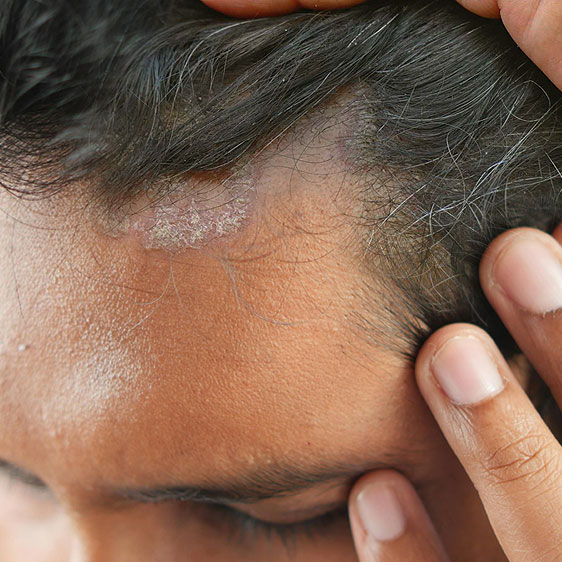
- Raised, red patches of skin covered with silvery scales (plaque psoriasis, the most common type)
- Small, drop-shaped pink spots, often after a strep throat infection (guttate psoriasis)
- Smooth red patches in skin folds like the armpits or groin (inverse psoriasis)
- White pustules surrounded by red skin (pustular psoriasis)
- Pitted, thickened, or discolored fingernails or toenails (nail psoriasis)
- Thick, flaky scalp patches that may extend past the hairline (scalp psoriasis)
- Dry, cracked skin that may bleed
- Itching, burning, or soreness
- Stiff, swollen joints (psoriatic arthritis)
What Triggers
Psoriasis?
Psoriasis is driven by genetics and immune system dysfunction. Flares are often triggered by:
- Stress
- Skin injuries (cuts, scrapes, sunburns, tattoos, bug bites)
- Infections, especially strep throat
- Certain medications, including some blood pressure and antimalarial drugs
- Cold, dry weather
- Smoking and heavy alcohol use
- Hormonal changes
EXPERT CARE
How We Treat Psoriasis
The right treatment depends on the type, severity, and location of your psoriasis. Many patients respond well to topical treatments alone. Others need a combination of approaches. Options include:
Topical treatments
Including corticosteroids, vitamin D analogs, retinoids, and newer non-steroidal options. Often the first line for mild to moderate psoriasis.
Phototherapy
Carefully controlled exposure to ultraviolet light, especially narrow-band UVB. Highly effective for moderate psoriasis. Available at our Chattanooga and Cleveland offices.
Oral systemic medications
Including methotrexate, cyclosporine, and apremilast. Used for moderate to severe psoriasis when topicals are not enough.
Biologic medications
Targeted injectable or infused therapies that block specific parts of the immune response. These have transformed psoriasis treatment, with many patients achieving 90 percent or better skin clearance.
Lifestyle support
Stress management, weight management, smoking cessation, and skincare routines that support your skin barrier.
Frequently asked Questions
No. Psoriasis is not contagious. You cannot catch it by touching someone’s plaques, sharing items, or being close to them. It is a genetic, autoimmune condition.
There is no cure for psoriasis, but it can be controlled extremely well, often to the point of clear or nearly clear skin. Many patients on modern biologic medications go years without significant flares.
Both cause red, itchy patches, but they are different conditions. Eczema typically appears in skin creases and is usually more itchy than painful. Psoriasis often appears on the elbows, knees, and scalp with thicker, silvery scales and can be painful or burning. Your dermatologist can tell them apart with an exam, and sometimes a small biopsy.
Modern biologics have a strong safety record, but they do affect the immune system. Your dermatologist will discuss the benefits and risks based on your medical history, run appropriate screening tests, and monitor your treatment over time.
Up to 30 percent of psoriasis patients develop psoriatic arthritis. If you have joint pain, stiffness, or swelling, tell your dermatologist. We may refer you to a rheumatologist for evaluation, and we coordinate care across specialties.
Ready to Take Control
of Your Psoriasis?
Psoriasis care has changed. Schedule a visit and let us walk you through the options that could finally work for your skin.