
Most moles are completely harmless, but some can be early signs of melanoma, the most serious form of skin cancer. You should see a dermatologist about a mole if it’s changing in size, shape, or color, if it looks noticeably different from your other moles, if it bleeds or itches without a clear reason, or if it appeared recently and is growing. The average adult has between 10 and 40 moles, according to the American Academy of Dermatology, and the vast majority of them will never cause a problem. But melanoma can develop in an existing mole or show up as a brand-new spot, and the difference between a harmless mole and an early melanoma isn’t always obvious to the untrained eye. That’s why knowing what to watch for, and knowing when to pick up the phone, matters. At Chattanooga Skin and Cancer Clinic, our board-certified dermatologists evaluate moles and suspicious spots every day across our Chattanooga, Cleveland, and Kimball offices. A quick evaluation can either put your mind at ease or catch something early when treatment is simplest.
What Does a Normal Mole Look Like?
A normal mole is usually a small, round or oval spot on the skin that’s one uniform color, typically brown, tan, or flesh-toned. It has smooth, well-defined borders, and it stays roughly the same size and shape over time. Most moles appear during childhood and adolescence, and it’s normal for them to darken slightly during pregnancy or with sun exposure.
Normal moles can be flat or raised. They can be tiny dots or up to about a quarter-inch across. Some have hair growing from them, which is actually a reassuring sign because melanoma rarely grows hair. The defining characteristic of a normal mole is stability. It looks the same month after month, year after year.
That stability is exactly what you’re tracking when you do monthly self-skin checks. Once you know what your moles normally look like, a change stands out.
What Makes a Mole Suspicious?
Dermatologists use the ABCDE criteria to evaluate whether a mole warrants a closer look. Asymmetry: one half of the mole doesn’t mirror the other. Border irregularity: the edges are jagged, scalloped, or blurred rather than smooth. Color variation: multiple shades of brown, black, red, white, or blue within a single mole. Diameter: the spot is larger than 6 millimeters (roughly the size of a pencil eraser), though melanomas can be smaller. Evolution: the mole is changing in any way, whether that’s size, shape, color, elevation, or texture.
Of these five, evolution is the most clinically useful. A mole that was stable for 20 years and suddenly starts growing, darkening, or developing an irregular border is worth a visit regardless of whether it checks every other box. Change is the signal.
There’s also the “ugly duckling” sign: a mole that looks distinctly different from all the others on your body. Most of a person’s moles tend to share a general family resemblance. If one spot is clearly the outlier, it deserves attention.
Can a Mole Turn Into Melanoma?
Yes, though most melanomas actually arise as new spots rather than from existing moles. A study published in the Journal of the American Academy of Dermatology found that roughly 70% of melanomas develop on previously normal-appearing skin, while about 30% arise from pre-existing moles. This means both new spots and changing old ones need monitoring.
When melanoma does develop within an existing mole, it typically causes visible changes: the mole gets larger, its color becomes uneven, its border becomes irregular, or it starts to feel different (itching, tenderness, or a sensation of firmness underneath). These changes usually happen over weeks to months rather than overnight.
The good news is that melanoma caught at its earliest stage (melanoma in situ, confined to the outer layer of skin) has a nearly 100% five-year survival rate. Catching it at a later stage, after it has grown deeper, drops that rate considerably. The thickness of the melanoma at the time of diagnosis is the single strongest predictor of outcome, which is why speed matters.
What Happens When a Dermatologist Evaluates a Mole?
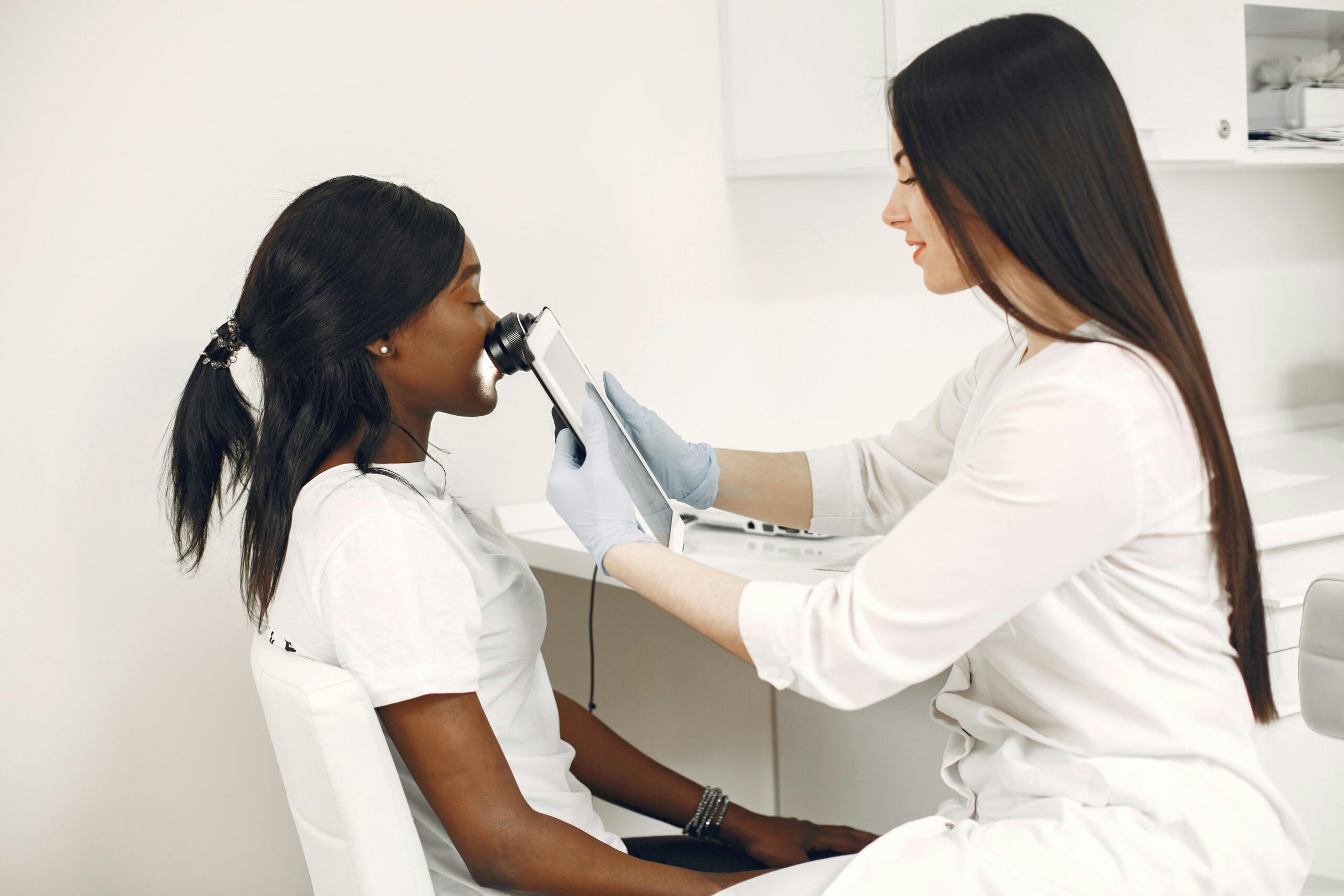
The evaluation is quick and painless. Your dermatologist will look at the mole with the naked eye first, then use a dermatoscope, a handheld magnifying device with polarized light that reveals structures beneath the skin surface that aren’t visible otherwise. Dermatoscopy has been shown to improve diagnostic accuracy for melanoma by 20% to 30% compared to examination without magnification.
Based on the dermatoscopic pattern, your dermatologist will either reassure you that the mole looks benign, recommend monitoring it over time with serial photographs, or recommend a biopsy. If a biopsy is recommended, it’s done in the office that same day.
A skin biopsy involves numbing the area with a small injection and then removing part or all of the mole. The tissue is sent to a dermatopathologist (a specialist in diagnosing skin diseases under a microscope), and results typically come back within one to two weeks. If the biopsy shows melanoma or another concern, your dermatologist will walk you through next steps, which may include a wider excision or referral to an oncologist depending on the depth and type.
Do Atypical Moles Always Become Cancer?
No. Atypical moles (also called dysplastic nevi) are moles that look unusual under the microscope but aren’t melanoma. They tend to be larger than normal moles, with irregular borders and uneven coloring. Having atypical moles does increase your statistical risk of developing melanoma over your lifetime, but most atypical moles never become cancerous.
Think of it this way: atypical moles are a risk marker, not a guarantee. Someone with many atypical moles and a family history of melanoma should be monitored more closely (typically every six months rather than annually), but there’s no reason to panic about every unusual-looking spot.
Your dermatologist can help you sort out which of your moles need monitoring, which can be left alone, and which should be removed. That kind of personalized risk assessment is hard to replicate on your own, which is another reason professional exams matter.
Are There Mole Changes That Are Not Concerning?
Yes. Moles can change in ways that are completely benign. During puberty, moles may darken or grow slightly. During pregnancy, hormonal changes can cause moles to become darker or larger temporarily. As people age, moles sometimes lose color and become flesh-toned or slightly raised. A mole that was flat in your 20s and becomes slightly dome-shaped in your 50s is following a normal aging pattern.
Irritation from clothing, shaving, or friction can also cause a mole to become red, tender, or slightly swollen. If the irritation resolves within a week or two and the mole returns to its normal appearance, that’s usually nothing to worry about.
The distinction comes down to pattern versus persistence. A mole that changes briefly due to an obvious external cause and then returns to baseline is different from a mole that is progressively changing over weeks without a clear trigger. When in doubt, a professional opinion takes the guesswork out of it.
How Can You Keep Track of Your Moles Over Time?
The most practical method is a combination of monthly self-checks and photography. Pick one day each month and examine your skin head to toe in a well-lit room with a full-length mirror and a hand mirror. Photograph any moles you want to track, placing a coin or ruler next to them for scale. Store the photos in a dedicated album on your phone so you can compare month to month.
Some dermatology practices offer full-body photography and mole mapping, where every mole is professionally photographed and catalogued so that new or changed spots can be identified at subsequent visits. This is particularly useful for patients with a high mole count or a strong family history of melanoma.
At Chattanooga Skin and Cancer Clinic, we work with patients to establish a monitoring plan that matches their individual risk level. For most people, that means annual professional exams combined with monthly self-checks at home. For higher-risk patients, it may mean exams every three to six months.
Frequently Asked Questions About Moles and Melanoma
Should I be concerned about moles my children have?
It’s normal for children to develop moles throughout childhood and adolescence. Most childhood moles are benign. However, if a mole on your child is rapidly growing, has multiple colors, or looks very different from their other spots, have a pediatric dermatologist or board-certified dermatologist evaluate it. Chattanooga Skin and Cancer Clinic treats patients of all ages, including children.
Can a mole biopsy cause cancer to spread?
No. This is a common myth. Biopsying a mole does not cause cancer to spread. A biopsy is the only way to determine whether a suspicious spot is cancerous, and delaying a biopsy out of fear gives a potential cancer more time to grow.
Where can I have a mole evaluated near Chattanooga?
Chattanooga Skin and Cancer Clinic evaluates moles at all three locations: Chattanooga (6061 Shallowford Road, 423-899-2700), Cleveland (3891 Adkisson Drive, 423-479-8648), and Kimball (400 Dixie Lee Center Rd, 423-815-9975). Appointments are available Monday through Friday.